
Last updated September 22, 2026
Free written scope consultation - allowances, timeline, and change-order rules on paper before a single trade is scheduled
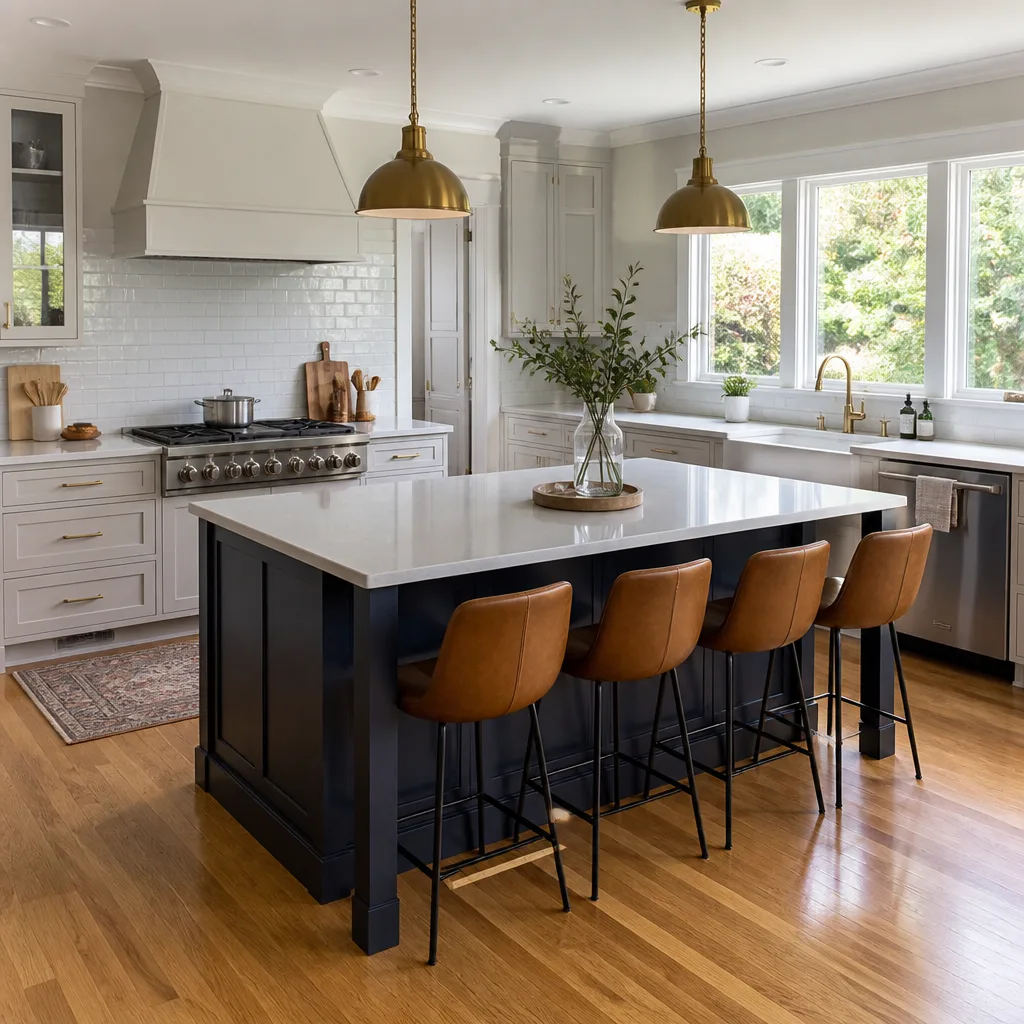
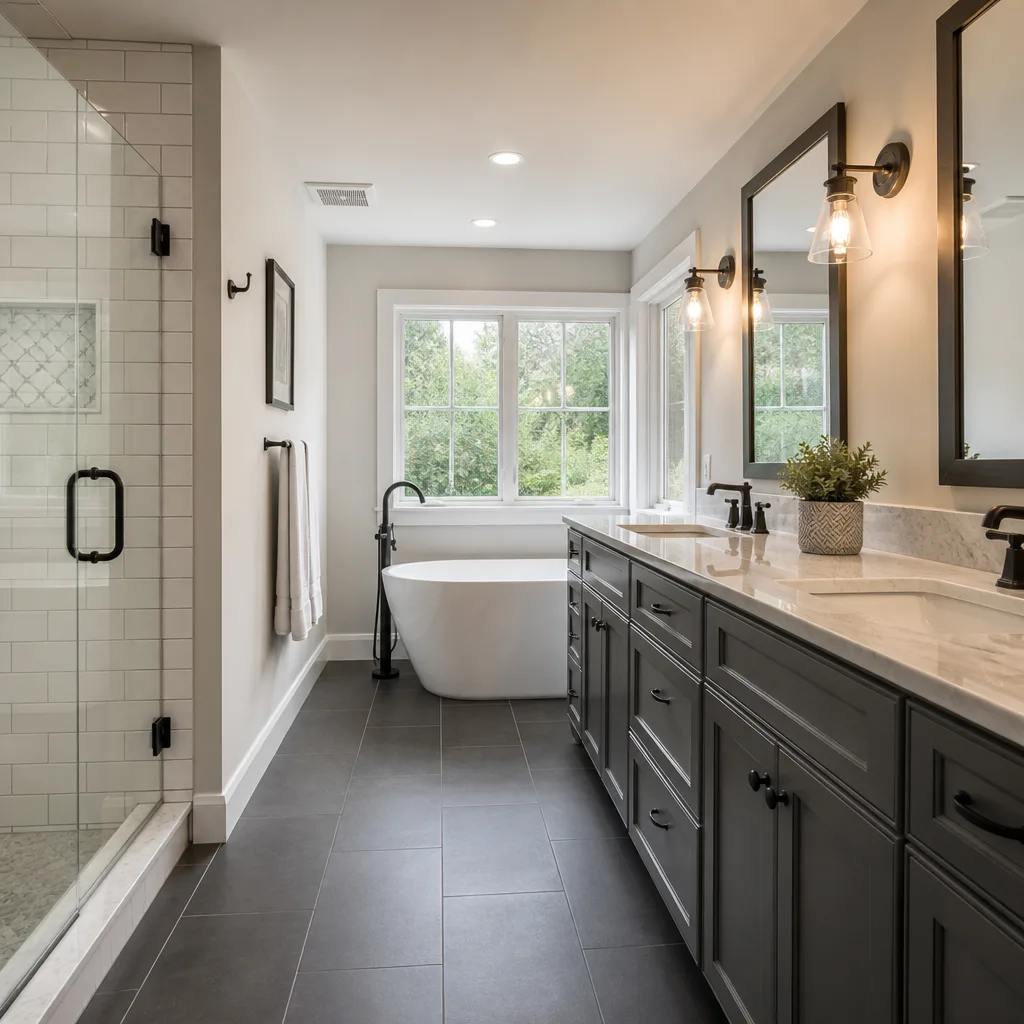
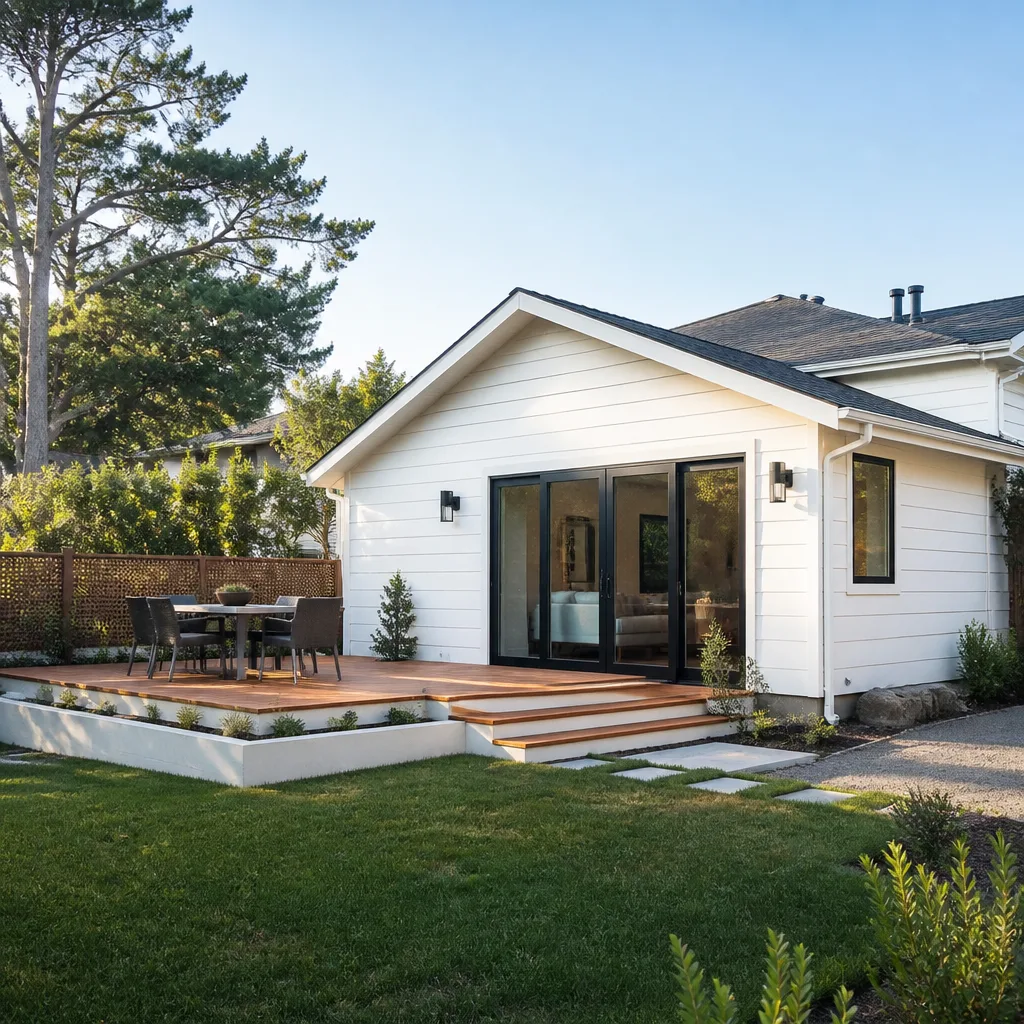

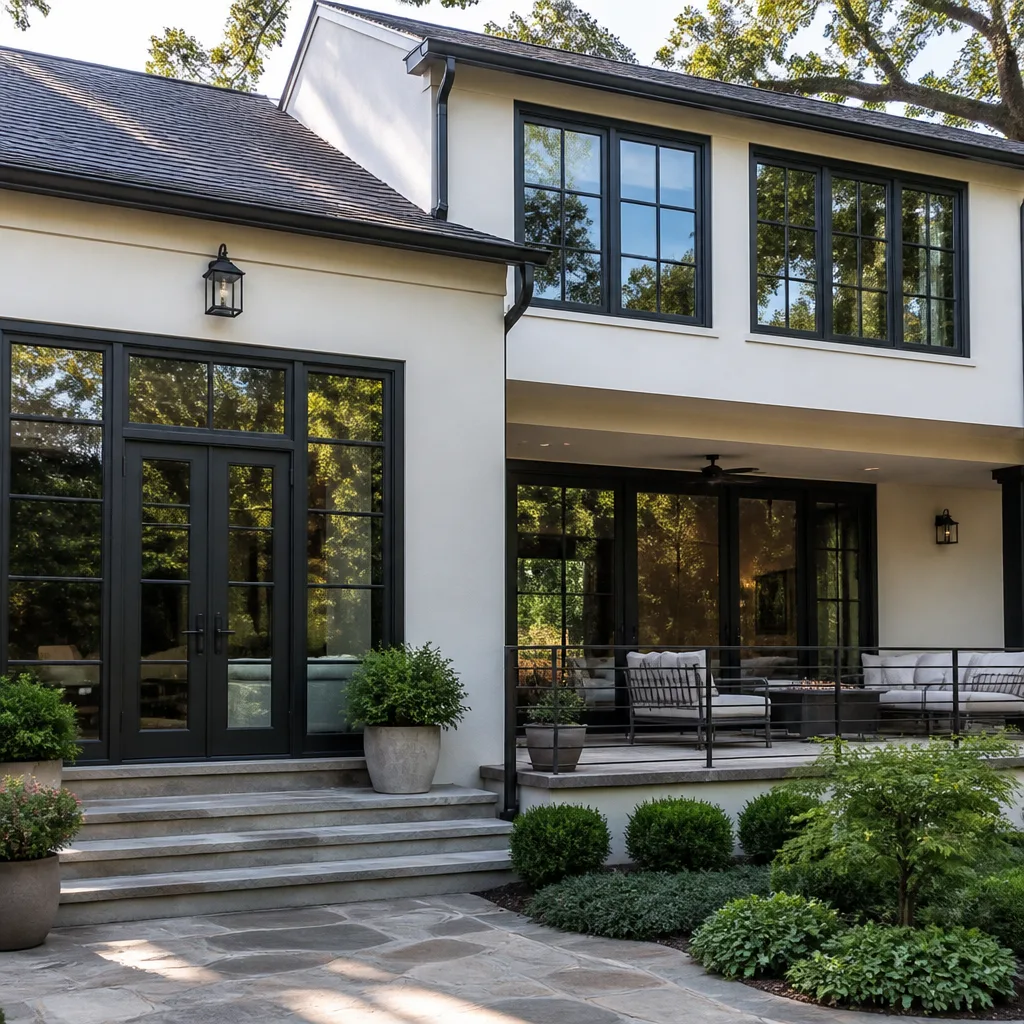

 Before
 After
After Before
 After
After Before
 After
AfterKitchen Remodeling Maintenance Checklist for West Palm Beach Homeowners
The average our Kitchen Remodeling services project in West Palm Beach runs $28,000-$75,000 depending on scope and materials. Most of that investment degrades not from catastrophic failure but from skipped 90-day checks on caulk seams and exhaust fan CFM ratings that cost under $200 to maintain and $3,000-$8,000 to remediate. In our experience across 4,000-plus projects since 2007, the kitchens that look new at year five are the ones where homeowners treated the first 365 days after completion as a scheduled inspection period, not a honeymoon.
This guide gives you that schedule: what to inspect, how often, and what a repair costs before it becomes a replacement. Every item is specific to South Florida’s climate, West Palm Beach’s common construction types, and the material brands we specify in our kitchen remodeling in West Palm Beach quotes.
Quick Answer
A proper kitchen remodeling maintenance checklist for West Palm Beach homeowners includes three inspection phases: 30-day checks for installation settling, 90-day checks for humidity-driven joint movement, and annual checks for ventilation performance and plumbing integrity. The critical items are cabinet box joints (especially plywood vs. MDF substrates), grout lines in slab-on-grade floor tile, under-sink plumbing at galvanized-to-copper transitions, and exhaust fan CFM verification using a simple tissue test. Budget $150-$400 per year for proactive maintenance; deferred repairs typically run $3,000-$8,000 in this market.
Table of Contents
- Why Maintenance Matters in West Palm Beach
- The 30/90/365-Day Inspection Schedule
- Cabinet Box and Door Joint Checks: Plywood vs. MDF
- Grout, Tile, and Slab-on-Grade Considerations
- Under-Sink Plumbing Inspection Points
- Exhaust Ventilation Performance Testing
- Countertop and Fixture Maintenance by Brand
- Common Mistakes to Avoid
- When to Call a Professional
- Frequently Asked Questions
- The Bottom Line
BeforeAfterWhy Maintenance Matters in West Palm Beach
West Palm Beach sits in USDA Hardiness Zone 10b with average relative humidity hovering at 75% year-round and summer spikes above 85%. That moisture load doesn’t just make afternoons uncomfortable; it creates a continuous expansion and contraction cycle in every organic material in your kitchen. Wood cabinet boxes swell in August and shrink in January. Grout lines in floor tile flex with the concrete slab beneath them. The adhesive bonds between countertop substrates and stone surfaces fatigue faster than they would in Phoenix or Denver.
The construction stock here compounds the issue. Much of West Palm Beach’s desirable in-town housing, from El Cid to Flamingo Park to Northwood, was built between 1920 and 1990. Those homes have galvanized steel supply lines, unconditioned wall cavities, and slab-on-grade foundations without moisture barriers that meet current Florida Building Code standards. A kitchen remodel replaces what you see, but it doesn’t always replace what’s behind the wall or below the floor. The maintenance checklist we use on our own projects accounts for that legacy infrastructure, as detailed in our Complete Guide to Construction in West Palm Beach.
We’ve documented the pattern across our project records: callbacks in year two or three trace back to skipped 90-day inspections in nine out of ten cases. The homeowner who checks cabinet door alignment at month three catches the hinge screw backing out before it wallows the pilot hole. The one who doesn’t ends up with a sagging door that stresses the face frame, then the box joint, then requires a $600-$1,200 cabinet repair or replacement. Under Clause 1 of the Haven Standard, we put the written price before work starts, but we can’t put a price on maintenance the homeowner never performs.
The 30/90/365-Day Inspection Schedule
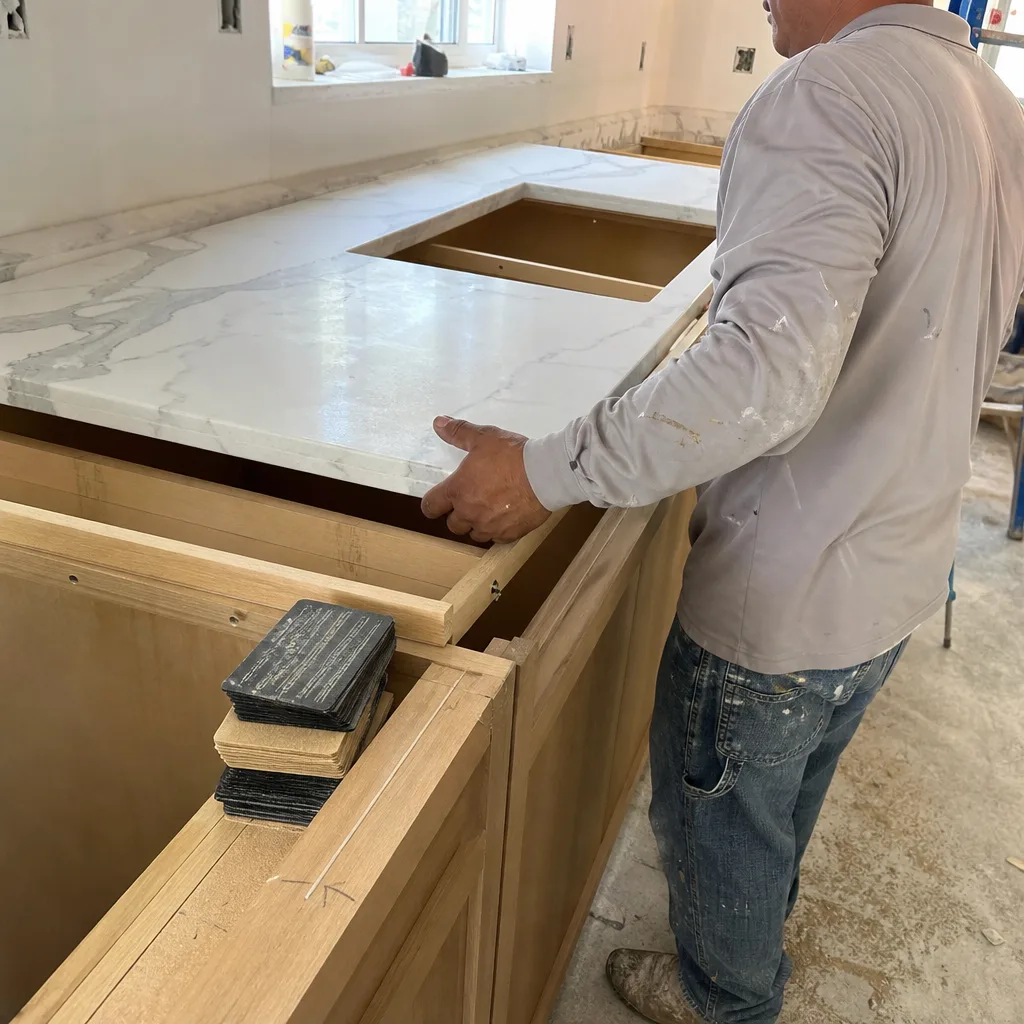
New materials settle, fasteners back out, and sealants cure unevenly. The first year after a kitchen remodel is when small issues become permanent problems or get caught early. We structure our client handovers around this schedule, and we recommend every West Palm Beach homeowner adopt it regardless of who did the work; find more guides & resources on our blog.
30-Day Check: Installation Settlement
- Cabinet door and drawer alignment. Open and close every door slowly. Listen for rubbing at the hinge side or catch interference. Check that drawer slides run full extension without binding. Temperature and humidity swings in the first month often reveal fasteners that need a quarter-turn more torque.
- Countertop seam inspection. Run a fingernail across every seam in stone or solid-surface countertops. Feel for a lip or gap widening. Seams in quartz and granite are epoxy-filled; the initial cure continues for 30 days and minor shrinkage is normal, but a visible gap needs re-filling before moisture penetrates.
- Caulk bead continuity. Inspect caulk at backsplash-to-countertop joints, sink deck-to-countertop perimeter, and window/door trim to drywall. South Florida’s humidity can prevent full cure if the AC was off during installation. Look for bubbles, skips, or sections that never skinned over.
- Plumbing leak test. Dry the cabinet base under sinks completely, then place a sheet of paper towel on the floor. Run hot and cold water at full pressure for two minutes each, checking the towel for damp spots. Test garbage disposal flange and dishwasher drain hose clamps.
- Appliance leveling and ventilation. Confirm range hood or microwave exhaust fan operates at all speeds. Verify refrigerator is level (front slightly high) so doors self-close. Check dishwasher is secure to counter or cabinet; loose units stress supply and drain hoses.
90-Day Check: Humidity-Driven Movement
- Cabinet box joint inspection. This is the critical check for West Palm Beach. See the next section for substrate-specific guidance.
- Grout line condition in floor tile. Walk the kitchen perimeter and high-traffic paths. Look for hairline cracks, powdering, or hollow-sounding tile. Slab-on-grade foundations in older West Palm Beach homes move with seasonal moisture; grout is the sacrificial element.
- Exhaust fan CFM verification. Perform the tissue test described in the ventilation section below. A fan that moved rated air at 30 days may have slowed due to ductwork settling or grease accumulation from heavy cooking.
- Window and door operation. Humidity swells wood trim. Check that windows open and latch without forcing; binding now prevents proper closure during storms.
- Under-sink plumbing re-inspection. Repeat the paper towel test. Galvanized-to-copper transitions, common in pre-1990 West Palm Beach homes, often show first seepage at 60-90 days as vibration from disposal use works the joint.
365-Day Check: Annual Baseline
- Full cabinet hardware torque check. Hinge screws, drawer slide brackets, pull handles, and knob screws. Use a manual screwdriver, not a drill, to avoid stripping.
- Grout sealant reapplication. Natural stone tile and cement grout need penetrating sealer annually in this climate. Test with water droplets; if they darken the grout rather than beading, reseal.
- Exhaust duct cleaning or inspection. Remove and clean grease filters. Check duct termination outside for lint or grease buildup that restricts airflow.
- Plumbing supply valve exercise. Turn angle stops off and on twice to prevent mineral locking. Replace any valve that doesn’t seat positively or drips after closing.
- Countertop polish and seal. Granite needs resealing; quartz does not but benefits from pH-neutral deep clean. Document condition with photos for year-over-year comparison.
Cabinet Box and Door Joint Checks: Plywood vs. MDF
This is where most kitchen maintenance guides fail. They tell you to “check cabinets” without explaining what failure looks like in the two dominant substrates, or why West Palm Beach’s humidity makes the distinction matter.
Plywood boxes are built from cross-laminated wood veneer sheets. The edges show distinct layers when viewed from below or inside. Plywood expands and contracts across its face but remains dimensionally stable through its thickness. In high humidity, the face of a plywood cabinet side panel may swell slightly, but the critical joint, where the side meets the back panel or the face frame, experiences minimal stress. What we see in West Palm Beach kitchens with plywood boxes is occasional veneer delamination at the edge, visible as a paper-thin lifting layer, or joint separation where staples or confirmat screws have backed out.
MDF (medium-density fiberboard) boxes are uniform brown-gray composite material with no visible grain. MDF swells dramatically when moisture penetrates exposed edges, and it does not return to original dimension when humidity drops. In our West Palm Beach project records, MDF box failures cluster in two locations: the sink base cabinet, where minor plumbing seepage wicks into the toe-kick or floor panel, and wall cabinets above coffee makers or kettles, where steam rises and penetrates the bottom panel’s unfinished edge.
To identify your substrate, open a cabinet door and look at the edge of the side panel. Plywood shows stripes; MDF shows a uniform, slightly fuzzy surface. If you have MDF, your 90-day check is more urgent. Look for these specific symptoms:
- Edge swelling: The bottom or side panel edge feels rounded or thicker than when installed. This is irreversible; the panel needs replacement before the swelling stresses adjacent joints.
- Face frame separation: The hardwood face frame pulls away from the MDF box, creating a visible gap at the corner. This indicates the box has expanded while the face frame, being solid wood, has not.
- Door hinge binding: The door closes harder than at 30 days, or the hinge arm no longer sits parallel to the face frame. The MDF behind the hinge plate has likely swollen, changing the screw angle.
In Northwood and El Cid renovations, we regularly specify plywood boxes for sink bases and any cabinet within 24 inches of a cooking surface, with MDF reserved for dry upper cabinets. If your remodel was done by a contractor who didn’t specify substrate by location, assume MDF throughout and inspect more frequently.
Repair costs in the West Palm Beach market: hinge plate relocation and screw repair, $85-$150; single cabinet box panel replacement, $400-$800; full sink base replacement due to floor panel swelling, $1,200-$2,400 including countertop detachment and reinstallation. The 90-day inspection that catches edge swelling costs nothing but time.
Grout, Tile, and Slab-on-Grade Considerations
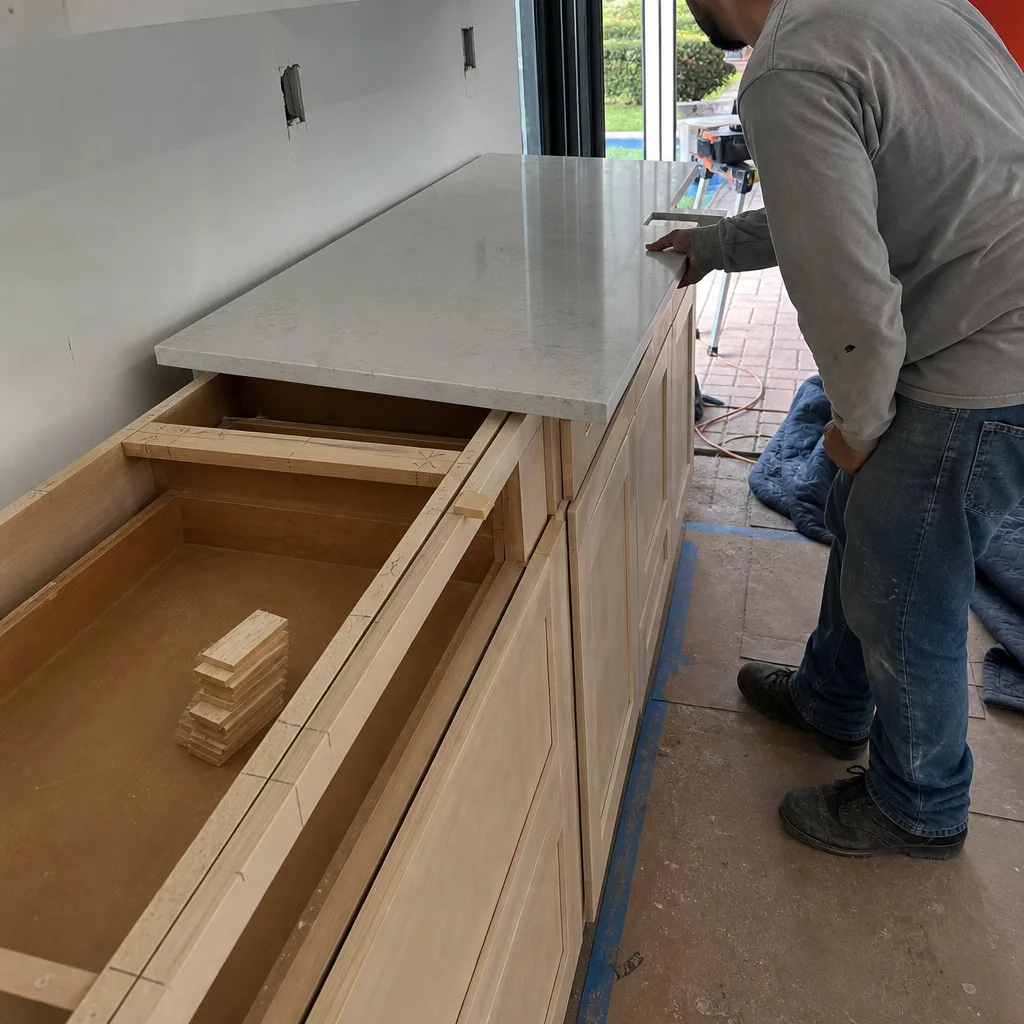
West Palm Beach’s older neighborhoods, from Vedado to Southland Park to the southern blocks of Flamingo Park, are built on slab-on-grade foundations poured directly on compacted shell and sand without a capillary break. That slab breathes moisture seasonally, and the tile installed over it moves in ways that tile on a wood subfloor does not, a pattern covered in our Seasonal Construction Care for West Palm Beach: Year-Round Homeowner’s Guide.
Unsanded grout is commonly used for joints narrower than 1/8 inch. It contains no silica sand aggregate and cures to a smoother, more porous surface. In dry climates, this is fine. In a West Palm Beach kitchen with 75% average RH and a slab that wicks ground moisture, unsanded grout in floor tile joints fails predictably: it powderizes at the surface, cracks with slab movement, and allows moisture to reach the tile adhesive. We’ve removed kitchen floors in El Cid homes where the unsanded grout failed at 18 months and the thinset beneath had reverted to loose sand.
Sanded grout, with added silica sand for strength, is the correct specification for floor tile joints 1/8 inch and wider, and we specify it for all kitchen floor applications regardless of joint width. It resists the compression and tension cycles of slab movement better, and its lower porosity when properly sealed repels the humidity that unsanded grout absorbs.
Your maintenance checklist for grout:
- 30 days: Visual inspection for voids or low spots where grout was not packed to full joint depth. These are installation defects, not wear, and should be addressed under warranty.
- 90 days: Check for hairline cracking in grout lines parallel to the kitchen’s longest wall, the direction of maximum slab flex. Tap tiles lightly with a coin; a hollow sound indicates debonding from slab movement.
- 365 days and annually: Water-drop test for sealer effectiveness. Reapply penetrating sealer if water darkens grout within five minutes. In West Palm Beach, we recommend annual resealing for cement-based grout, not the two-year interval suggested for drier climates.
Replacement economics: grout removal and regrouting a 10×10 kitchen floor, $800-$1,400; full tile and underlayment replacement where moisture has compromised thinset, $3,500-$7,000 depending on tile selection. The annual sealer application costs $40 in materials and two hours.
For homeowners considering bathroom remodeling in West Palm Beach, these same slab-on-grade and grout principles apply with even greater force, given the direct water exposure.
Under-Sink Plumbing Inspection Points
This is the highest-stakes inspection on the checklist because the damage is hidden until it’s extensive. In West Palm Beach’s pre-1990 housing stock, we encounter three specific conditions that demand attention.
Galvanized supply lines. Homes built before roughly 1985 in West Palm Beach often have galvanized steel water supply lines with threaded joints. The interior of these lines corrodes, reducing flow and creating turbulence that accelerates wear at connections. When a kitchen remodel installs new copper or PEX supplies from the wall stop to the faucet, the transition point, galvanized female to copper male, is a galvanic corrosion site. It may hold at installation but develop pinhole seepage as the dissimilar metals interact in humid cabinet air.
Your 30-day and 90-day paper towel tests are designed to catch this. But also look for these specific indicators:
- Reduced hot water flow at the faucet compared to cold, indicating interior galvanized corrosion on the hot line (which corrodes faster due to thermal expansion cycles).
- Corrosion staining on the cabinet floor or back panel below the supply stops, orange-brown for galvanized, green for copper.
- Stiff or grinding angle stops when operated, suggesting mineral buildup from corroded upstream pipe.
Dishwasher drain hose routing. The high-loop or air gap prevents sink drain backflow. In West Palm Beach, grease from cooking and garbage disposal use combines with humidity to form a sticky film in drain hoses. Check that the hose is not sagging below the high-loop point, where this film accumulates and eventually blocks flow.
Garbage disposal flange seal. The three-bolt mounting assembly compresses a fiber gasket between the sink and disposal body. Vibration from disposal operation works these bolts loose over 60-90 days. A loose flange allows water to track between the sink and counter, damaging the substrate below. The 30-day check should confirm bolt tightness; the 90-day check should verify no wobble in the disposal body when manually rocked.
Repair costs: angle stop replacement with proper dielectric union, $150-$280; disposal flange reseal, $85-$140; full supply line replacement from galvanized main to fixture, $800-$1,800 depending on access. Cabinet floor panel replacement from undetected leak damage, $400-$900. The inspection takes ten minutes.
Exhaust Ventilation Performance Testing
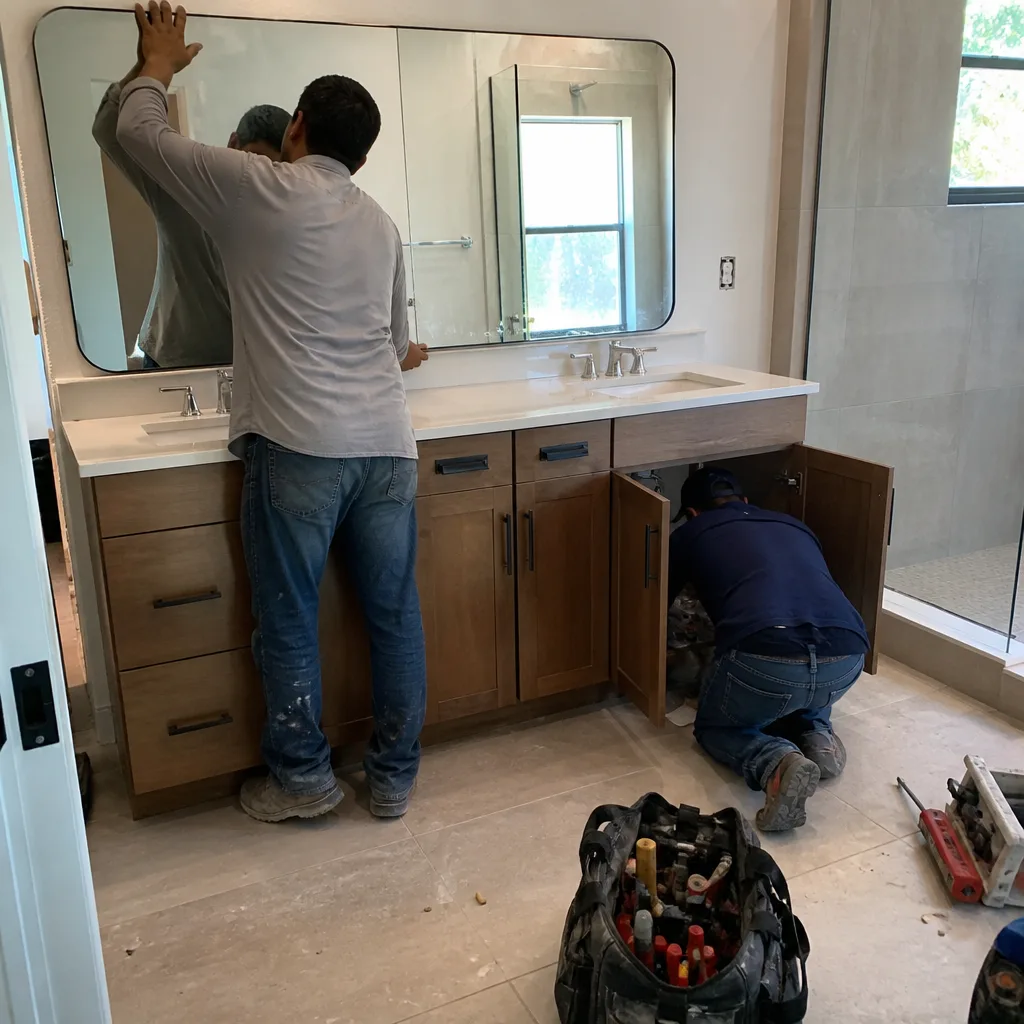
Kitchen exhaust is the most neglected system in residential construction, and in West Palm Beach’s humidity, a marginal fan is a cabinet destroyer. The Florida Building Code requires a minimum 100 CFM (cubic feet per minute) for range hoods or 300 CFM for microwave-hood combinations, but minimum code and adequate performance are not the same in a climate where outdoor air is saturated half the year.
A fan rated at 300 CFM may deliver 180 CFM at the grille after duct friction losses, especially if the previous contractor used flexible ducting with ridges, ran excessive horizontal lengths, or terminated with a cheap flapper damper that sticks half-open. The humid outdoor air that backflows through a stuck damper deposits moisture on cabinet faces and promotes mold in the duct.
The tissue test: This is not sophisticated, but it is definitive. Hold a single sheet of facial tissue against the grille with the fan on high. A properly performing 300 CFM microwave hood should hold the tissue firmly against the grille without slipping. A 100 CFM range hood should at minimum prevent the tissue from falling away. If the tissue slides down or flutters loose, the fan is underperforming.
Causes of underperformance, in order of frequency in our West Palm Beach service calls:
- Grease-laden filter. Remove and degrease in hot water with dish detergent. Replace if the mesh is damaged or permanently stained. This restores 15-30% of lost airflow in most cases.
- Stuck or missing damper at exterior termination. The damper should open fully under fan pressure and close fully when off. Replace if the flapper is warped or the spring is missing. In West Palm Beach, we see wasp nests in dampers with surprising frequency.
- Duct leakage or disconnection. Common where flex duct was used and has pulled from a coupling. This dumps moisture and grease into the attic or wall cavity, not just the kitchen.
- Fan motor degradation. Bearings wear; humidity accelerates corrosion in the motor housing. Replacement motors for major brands run $45-$120; installed with labor, $85-$220.
The cost of inadequate ventilation: moisture damage to cabinet faces above the range, $600-$1,500 for refinishing or replacement; mold remediation in ductwork or wall cavities, $1,200-$3,500; structural repair where long-term moisture has compromised drywall or framing, $2,000-$5,000. The tissue test costs a tissue.
For homeowners also evaluating roofing in West Palm Beach, the same attention to ventilation, attic airflow, and humidity management applies at the whole-house level.
Countertop and Fixture Maintenance by Brand
Your maintenance routine varies by material specification. In our kitchen remodeling in West Palm Beach quotes, we specify brands and product lines with documented performance in humid climates, and we document those specifications in the written scope so the homeowner knows what they have.
Cambria quartz countertops. Engineered quartz is non-porous and does not require sealing. Maintenance is straightforward: pH-neutral cleaner, no bleach or ammonia, no abrasive pads. The resin binder can discolor with prolonged heat exposure above 300°F, so trivets remain necessary. In West Palm Beach’s UV exposure, lighter colors show less yellowing over time than warm whites; we note this in our material selection consultations.
Caesarstone quartz. Similar performance to Cambria with a broader color palette. The polished finish is more stain-resistant than honed; we specify polished for kitchens unless the homeowner accepts the additional maintenance. Annual deep cleaning with a quartz-specific product removes the film that builds from cooking oils and humid air.
KraftMaid cabinet finishes. The standard catalyzed conversion varnish on KraftMaid doors is highly moisture-resistant. Maintenance is damp-cloth cleaning with mild detergent, followed by dry cloth. Avoid furniture polishes containing silicone, which build a film that attracts dust in humid air. The All-Plywood Construction upgrade we specify for sink bases uses PureBond formaldehyde-free plywood; edge sealing is factory-applied and should not require homeowner attention.
Wellborn cabinet finishes. The Opaque paint line on MDF center panels requires more careful handling than stained wood or laminate. Dings that penetrate the paint film allow moisture into the substrate; touch-up paint should be applied promptly. We include a touch-up kit in every Wellborn kitchen delivery.
Kohler and Toto fixtures. Both brands use ceramic disc cartridges with lifetime lubrication. The maintenance item is aerator cleaning, where hard water deposits from West Palm Beach’s limestone aquifer accumulate. Unscrew the aerator monthly and soak in white vinegar for 15 minutes. For Toto’s EcoPower sensor faucets, battery replacement or turbine cleaning per the model-specific interval.
The principle across all brands: use the manufacturer’s specified cleaner, not a general-purpose product. The warranty depends on it, and in our experience, improper cleaner use is the leading cause of finish claims that manufacturers deny.
Common Mistakes to Avoid
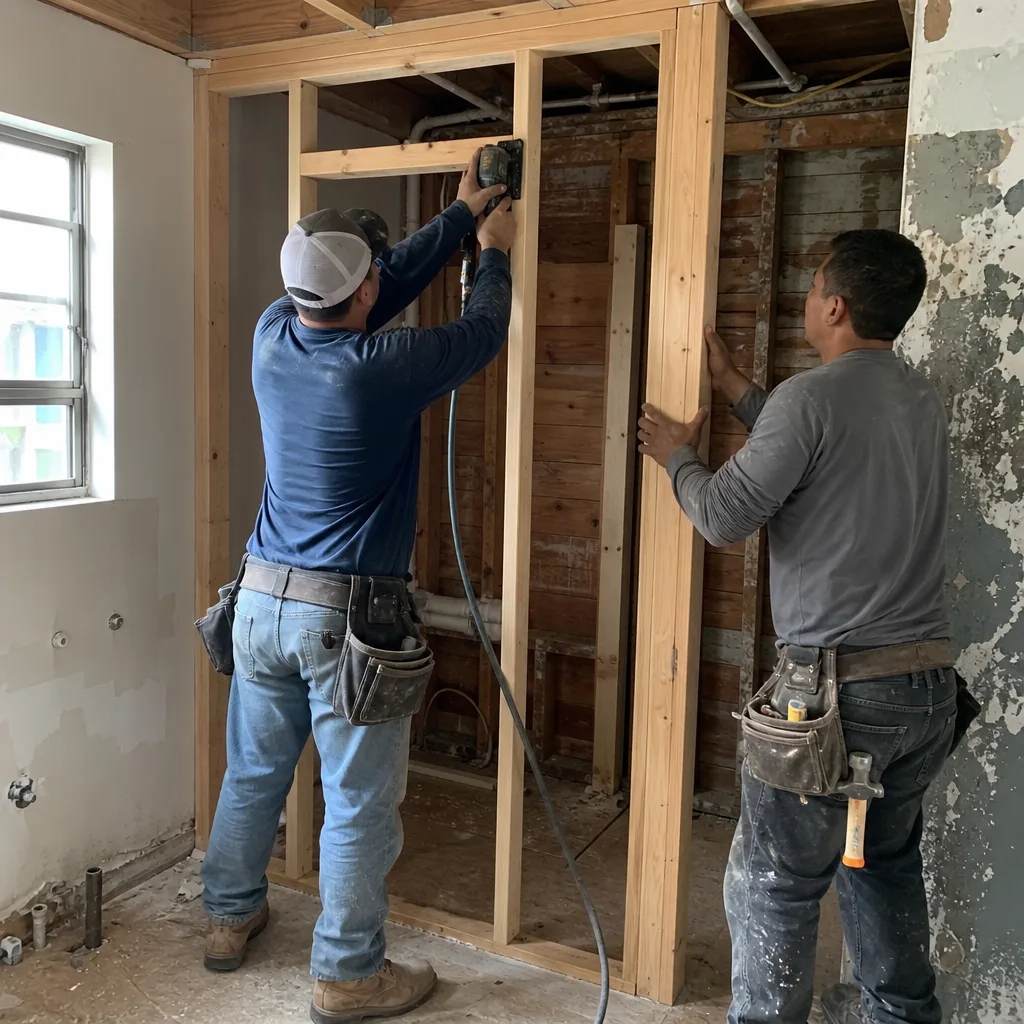
- Using a steam cleaner on cabinets or countertops. The 212°F steam drives moisture into edge joints and through microscopic finish imperfections. We’ve replaced cabinet panels in Northwood homes where weekly steam “sanitizing” swelled MDF boxes within 14 months.
- Skipping the 90-day check because “everything looks fine.” Humidity-driven movement is not visible from across the room. The hinge screw that backs out 1/16 inch at 90 days is the sagging door at 18 months. The grout hairline at 90 days is the hollow tile at 24 months.
- Applying granite sealer to quartz. Quartz does not absorb sealer; it creates a hazy residue that requires professional polishing to remove. Read the material specification in your project documentation, or call us for identification if records are unavailable.
- Ignoring a slow under-sink drip because the cabinet floor “is vinyl anyway.” The vinyl overlay on cabinet floors is a wear surface, not a moisture barrier. Water penetrates at seams and fasteners, and the particleboard or plywood beneath swells and delaminates. By the time the vinyl bubbles, the substrate is destroyed.
- Running the exhaust fan only when smoke is visible. The fan’s job is moisture and pollutant removal, not smoke evacuation. In West Palm Beach’s humidity, running the fan for 15 minutes after cooking removes the moisture load that would otherwise condense on cooler cabinet surfaces overnight.
- Using generic “multi-surface” cleaners on brushed nickel or matte black fixtures. These finishes use physical vapor deposition (PVD) coatings that certain solvents damage. Kohler and Toto specify their cleaners for reason; we include care cards with every fixture installation.
- Deferring maintenance to “when we sell.” Deferred maintenance does not preserve value; it compounds repair costs and reduces sale price. A kitchen with swollen MDF cabinets and failed grout does not show well, and the inspection report will flag systems the buyer expects to function.
When to Call a Professional
Some conditions exceed homeowner maintenance and require trained assessment. Call a licensed contractor if you find: cabinet box swelling that has changed door alignment beyond hinge adjustment; tile that sounds hollow across more than 10% of the floor area; any water staining on drywall or ceiling below the kitchen; exhaust fan airflow below the tissue-test threshold after filter and damper cleaning; or galvanized supply lines with active corrosion that reduces flow.
Rowan Construction Group West Palm Beach offers free estimates in West Palm Beach. We’ll inspect the condition, document it with the photo record included on every visit, and provide a written price before any work starts. Our 365-Day Done Right Promise applies to any repair we perform. Call (561) 475-3903 to schedule.
Frequently Asked Questions
Proactive maintenance for a typical remodeled kitchen runs $150-$400 annually, covering sealant, filters, minor hardware, and cleaning supplies. Deferred repairs that result from skipped maintenance average $3,000-$8,000 in the West Palm Beach market, based on our project records since 2007. Call (561) 475-3903 for an exact assessment of your kitchen’s condition - estimates are free.
Open a cabinet door and examine the edge of the side panel. Plywood shows distinct horizontal layers, like a sandwich of wood sheets. MDF shows a uniform, slightly fuzzy brown-gray material with no visible grain. The substrate should also be listed in your project documentation or material specification sheet from the original contractor.
Recurrent grout cracking in West Palm Beach kitchens usually indicates one of three conditions: unsanded grout in floor joints that cannot withstand slab movement; thinset debonding from the slab due to moisture vapor transmission; or missing movement joints (perimeter isolation or field expansion joints) that allow stress accumulation. A proper repair addresses the substrate condition, not just the grout surface. Call (561) 475-3903 and we’ll assess whether the fix is localized or requires floor system modification.
Under Clause 1 of the Haven Standard, Rowan Construction Group delivers a written price before any work starts, every time. If we discover concealed damage during maintenance work, we document it with photos, present a written change order with the exact additional cost, and no work proceeds until you sign. This discipline has kept our projects within a few percent of the agreed price across 4,000-plus jobs since 2007.
Granite countertops in South Florida’s humidity should be resealed annually, not every two to three years as general guidance suggests. Test by placing water droplets on the surface; if they darken the stone within five minutes rather than beading, the sealer has degraded. Quartz countertops do not require sealing.
Routine maintenance, sealant application, filter replacement, and hardware adjustment do not require permits in West Palm Beach. Repairs that modify plumbing supply lines, electrical circuits, or structural elements may require permitting depending on scope. Rowan Construction Group pulls all required permits and schedules inspections as part of any repair that crosses that threshold; the permit cost is included in the written quote, not added later.
The Bottom Line
A kitchen remodel in West Palm Beach represents a significant investment in a climate that tests every material choice. The homeowners who protect that investment are not the ones who selected the most expensive countertop; they are the ones who performed the 30/90/365-day inspection schedule and caught the hinge screw, the grout hairline, and the under-sink damp spot before they became cabinet replacement, floor demolition, and mold remediation. The maintenance cost is modest, the inspection time is minimal, and the documentation you keep creates a record of care that preserves function and value. Start with the 30-day checklist this week, schedule the 90-day check in your calendar now, and treat the first year as the foundation for the next twenty.
Written by Grant Rowan, Owner at Rowan Construction Group West Palm Beach home, serving West Palm Beach since 2007.